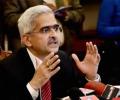
The overarching talking point will be the reluctance on the part of private banks to loosen their purse strings and increase lending substantially, even as the central bank believes there is adequate liquidity within the system.

'India has the potential to do a lot more to take advantage of the time today where we stand to gain, geopolitically and in terms of market attractiveness.'

Strong month-end demand for the US currency mainly from oil importers along with currency futures expiry related purchases predominantly weighed heavily on the forex market and haunted investor sentiment.

JP Morgan's decision last week to include Indian government bonds in its Government Bond Index-Emerging Markets (GBI-EM) index and the index suite from June 2024 may be a sort of blessing for India, as the move is estimated to result in an inflow of $25 billion of foreign portfolio investments into the country. The development comes at a time when the spread between the benchmark 10-year government of India bond and the 10-year US government bond has declined to its lowest level in more than 17 years. Low yield spreads make Indian bonds less attractive to foreign portfolio investors (FPIs).

Banking and financial stocks got more than their fair share of foreign portfolio investor (FPI) flows in February. Overseas investors pumped in $3.56 billion into domestic equities last month. Of this $1.96 billion went into financial stocks, data analysed by Edelweiss shows. "The sector now has 34.8 per cent of FPI assets, up from 33.8 per cent in January.

Among Sensex stocks, Wipro gained the most by 3.29 per cent. Ultratech Cement, Reliance Industries, Hindustan Unilever, Nestle, NTPC, M&M, HDFC Bank, ITC, Kotak Bank and Axis Bank were among the winners. On the other hand, HCL Tech fell the most by 1.24 per cent. SBI, TCS, Infosys, IndusInd Bank and Tata Steel also dropped.

The US dollar surged to fresh one-year high after the Fed chief's testimony to the US Senate on Wednesday bolstered the expectations of interest rate hikes, though gradually.

This is despite the private sector companies outperforming their public sector counterparts, reports Sachin P Mampatta.

Investors should view any bounce-back in bank stocks as an opportunity to exit the pack, analysts suggested, as the worst may not be over yet. The recent quarterly results of HDFC Bank and Axis Bank disappointed the Street, triggering a marketwide selloff by foreign institutional investors, especially in banking counters. While HDFC Bank, which was the anchor for the market correction during the past week, ended 2 per cent higher amid short covering on Wednesday, Axis Bank's shares settled 3 per cent lower.

Ahead of its Rs 18,000 crore further public offer (FPO), Vodafone Idea on Monday said it expects to roll out 5G services in select pockets within 6-9 months of raising fresh capital. Its chief executive Akshaya Moondra said rollout of the modern 5G telecom services is one of the objectives of raising the capital from the public and once the funding comes, it will start work on the rollout. "With this round of funding, we believe we will be able to (come) back to participate in the industry growth which has not been possible," he said.

'While Indian markets are indeed not inexpensive, the valuations of largecap stocks are still a considerable distance from being overstretched.'

Investors are anxious over the US-China trade tension, a sharp devaluation in yuan and uncertainty over Kashmir issue.

The rally in PSBs, analysts feel, was more a knee-jerk reaction to the development, and the actual benefits will start to accrue once the addition takes place in 2024. "The actual benefit for banks from the inclusion in JP Morgan's EM Index will accrue from June 2024 onwards. "Until then, the larger fundamentals of the market will dictate the moves. "Once the initial euphoria subsides, bond markets will look to global cues which may trigger fresh selling," said Siddharth Khemka, head of retail research, Motilal Oswal Financial Services.

The sharp rally in the markets thus far in fiscal 2023-24 (FY24) has left analysts struggling to find investment-worthy themes. The S&P BSE Sensex has surged nearly 7 per cent thus far in FY24 and hit a fresh 52-week high of 63,601.71 levels on June 22, mostly led by foreign institutional (FII) flows. "The Indian market has seen a broad rally in the past few months but headline indices have seen more modest performance. "We are not very clear about the reasons for the rally and the divergent performance and struggle to find ideas in the consumption, investment and outsourcing sectors after the sharp run-up in several of our favored sectors and stocks in the past two months," wrote Sanjeev Prasad, co-head, Kotak Institutional Equities, in a recent co-authored note with Anindya Bhowmik and Sunita Baldawa.

From the Sensex pack, State Bank of India, ICICI Bank, IndusInd Bank, Axis Bank, Kotak Mahindra Bank, HDFC Bank, Reliance Industries were among the major laggards. Bucking the trend, auto stocks Tata Motors and Mahindra & Mahindra closed with gains.

Perhaps the finance ministry or NITI Aayog could take a detailed look at what governments actually deliver and at what cost; how their services can be improved and expanded where necessary; how much money can be saved through doing things differently; and how many things the government does which it can safely leave to the private sector, argues T N Ninan.
The rumour verification process would now be triggered by changes in price or 'material price movements', as the paper defines it. What this means is that companies would need to verify rumours only if the share price moves significantly.

Fitch on Tuesday affirmed India's sovereign rating at 'BBB-' with a stable outlook, on robust growth and resilient external finances, but said weak public finances remain a challenge. India's rating has been unchanged at 'BBB-', which is the lowest investment grade, since August 2006. "Fitch Ratings has affirmed India's Long-Term Foreign-Currency Issuer Default Rating (IDR) at 'BBB-' with a Stable Outlook," it said in a statement, adding strong growth potential is a key supporting factor for the sovereign rating.

Active largecap funds, which have the toughest job in terms of outperforming the benchmark, did better in 2023 as their bets in the mid and smallcap stocks paid off.

Ongoing trade-war rhetoric between the US and China added some nervousness on the trading front coupled with extremely bullish dollar sentiment overseas.

Alternative investment funds (AIFs) - pooled investment vehicles catering to high net worth individuals (HNIs) - saw a 30 per cent increase in investment commitments during financial year 2022-23 (FY23). At the end of March 2023, the total investment commitments raised stood at Rs 8.33 trillion, up Rs 1.92 trillion from Rs 6.41 trillion at the end of March 2022. A commitment is the money clients are willing to put into AIFs.

The ballooning of crude prices has significantly increased the country's oil import bill and it can also lead to a worsening of the current account deficit and fiscal deficit for the domestic economy.

Kotak Mahindra Bank was the biggest loser from the Sensex pack, skidding 1.83 per cent, followed by Axis Bank, NTPC, Hindustan Unilever, ICICI Bank, Bharti Airtel, Reliance Industries, HCL Technologies, IndusInd Bank and Nestle. In contrast, Bajaj Finance, Bajaj Finserv, Tech Mahindra, Tata Consultancy Services, Titan, Infosys, HDFC Bank, HDFC and ITC were the gainers.

Host of lenders led by State Bank of India (SBI) and Bank of India hiked lending rates after the Reserve Bank raised the benchmark interest rate to tame inflation. The hike has been effected in their benchmark rate linked to the repo rate, which increased by half a percentage point to 5.9 per cent. Even financial institutions like mortgage lender HDFC Ltd hiked the lending rate by 50 basis points effective Saturday.
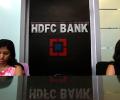
Growing concerns over slower-than-expected margin recovery, amid weak deposit growth have caught HDFC Bank's investors off guard. HDFC Bank's stock on Wednesday plunged nearly 9 per cent to hit an intraday low of Rs 1,527 on the BSE after reporting weaker-than-expected earnings in the third quarter (October - December) of the current financial year (Q3FY24). The shares of India's biggest private lender closed at Rs 1,536.9, down 8.46 per cent.

'If individual stocks start falling 25% to 30% or more, then I doubt how many of them will be able to withstand that (kind of selloff). That is when you'll see panic coming in.'

In the past few months, 45 companies have signalled their intent to raise money through the institutional placement route.
The rupee has been under immense pressure due to a host of reasons including soaring crude oil prices, sustained foreign fund outflows and widening current account deficit.
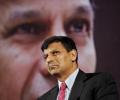
RBI chief Raghuram Rajan said Asia's third-largest economy is being hampered by a drop in public and private investments.

The Reserve Bank of India on Thursday opted for a pause second time in a row, maintaining key benchmark policy rate at 6.5 per cent as inflation moderates. The rate increase cycle was paused in April after six consecutive rate hikes aggregating to 250 basis points since May 2022. Announcing the bi-monthly monetary policy, RBI Governor Shaktikanta Das said the Monetary Policy Committee (MPC) unanimously decided to keep the rate unchanged at 6.5 per cent.

The domestic equity market, which is on a record-breaking spree, will focus on macroeconomic data announcements, movement in global stocks and the US Fed minutes to get further direction, analysts said. Trading activity of Foreign Institutional Investors (FIIs) will also innfluence investors.From the domestic macroeconomic front, Purchasing Managers' Index (PMI) data for the manufacturing sector will be released on Monday, and that o,f the services sector on Wednesday. Investors, this week, will keenly watch major global market events, icluding the outcome of the Federal Open Market Committee (FOMC) minutes, scheduled to be out on Wednesday.

"Financial bids for Air India disinvestment received by Transaction Adviser. Process now moves to concluding stage," DIPAM Secretary Tuhin Kanta Pandey tweeted.
HDFC Bank on Monday reported a consolidated net profit of Rs 16,811 crore for the September quarter, its maiden quarterly earnings announcement after merging parent HDFC with itself. On a standalone basis, the largest private sector lender reported a net profit of Rs 15,976 crore. In the year-ago period, the net profit of the merged entity would have been Rs 11,162 crore on a consolidated level while the same on a standalone basis would have been Rs 10,606 crore.
In a mixed bag for HDFC Bank ahead of the parent HDFC's merger with itself, the Reserve Bank of India has declined to make exceptions on certain aspects, and has offered some leeway on others. The country's largest private sector lender, which is aiming to conclude the merger with the home finance major by July, had written to the central bank seeking certain forbearances after announcing the $40-billion merger in April last year. In an exchange filing this evening, HDFC Bank said it received a response from RBI on Thursday and also said that there are a few pending issues.
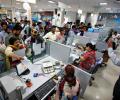
Currently, banks are closed every second and fourth Saturday of a month. Why shouldn't they be shut every Saturday? When most customers carry their banks in their pocket (the app on the mobile phone), there is no need to keep banks open on Saturdays, argues Tamal Bandyopadhyay.

Companies, which missed out on listing earlier, are giving it another shot but with significantly-reduced issue sizes. In the recent past, companies such as TVS Supply Chain Solutions, Suraj Estate Developers, and ESAF Small Finance Bank have re-filed their draft red herring prospectuses (DRHPs) with the Securities and Exchange Board of India (Sebi). This came after they slashed their issue sizes by 20-60 per cent.

Overall forex market sentiment suffered a sudden reversal of fortune contrary to expectation largely moving in line with local equities, reversing all early strong gains.

The most important positive of India's stealth bull market is earnings growth across different sectors, explains Debashis Basu.
HDFC Bank Q1FY24 results analysis: Shares of HDFC Bank, the world's seventh largest financial entity, have advanced 2 per cent in two days, as against 1 per cent rise in the benchmark S&P BSE Sensex, after the lender reported its April-June quarter (Q1) results for financial year 2023-24 (FY24) on July 17. The S&P BSE Bankex index, meanwhile, has gained 1.3 per cent. While the near-term stock performance may remain sideways due to merger-related hiccups, analysts remain bullish on the stock's long-term prospects.

When he didn't respond (Mr Saver has lost count of how many relationship managers he has had in the past few years!), the gentleman landed up at his doorstep and started pleading with him to open fixed deposits with the bank, observes Tamal Bandyopadhyay.
 © 2026 Rediff.com - Advertise with us - Disclaimer - Privacy Policy - Sitemap - Feedback - About us - Terms of use - Grievances